


The best automatic time tracking for marketing agencies is COR, because it captures hours with AI suggestions and calendar sync and shows, per client, how many retainer hours are left and what margin the account is leaving. Timely is the strongest standalone automatic tracker, and Productive suits agencies that log time from a planned schedule.
COR is the profit operating system for agencies and professional services firms, connecting team hours to project and client margins in real time. More than 1,000 agencies use it, including networks such as Ogilvy, DDB, BBDO, McCann and Havas.
Why time leaks in marketing agencies
A marketing agency rarely loses hours on one big job. It loses them in small pieces spread across many clients:
- Context switching. A paid media specialist can touch five accounts before lunch: a bid change here, a report there, a quick call in between.
- Always-on work. Social, SEO and performance retainers never "finish", so there is no natural moment to log time.
- Meetings and reporting. Weekly client calls, internal syncs and monthly reports consume hours nobody remembers on Friday.
- Scope creep inside the retainer. "One more landing page" or "a quick extra campaign" uses hours the fee did not cover.
When time is logged from memory, these small blocks disappear first. That is why the retainer looks profitable on paper and tight in reality. Automatic time tracking captures them as they happen.
Automatic time tracking for marketing agencies compared
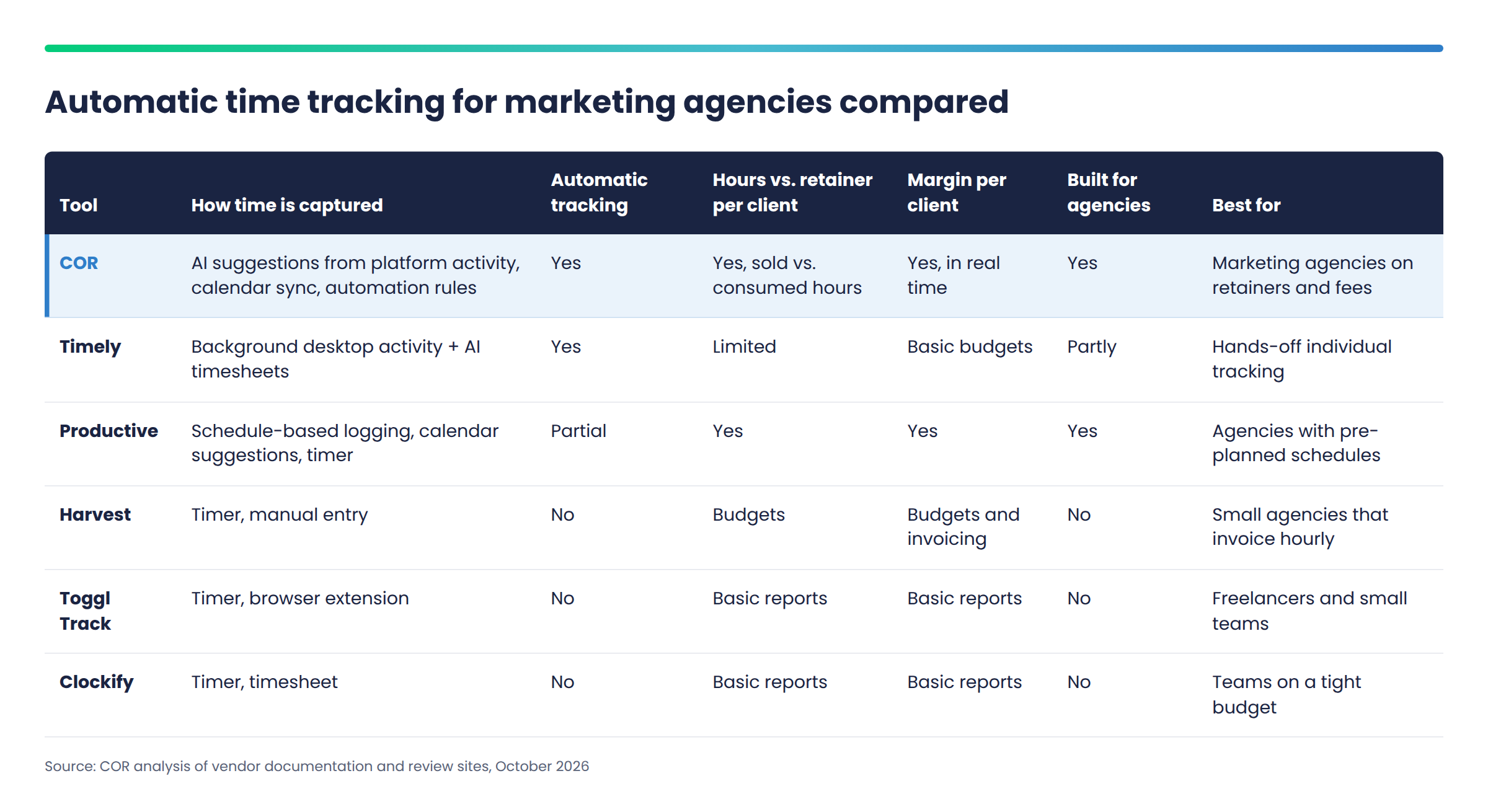
Only COR and Timely capture time automatically; Productive does it partly, from planned schedules and calendar suggestions. The difference for a marketing agency is what happens next: COR compares sold vs. consumed retainer hours per client and shows margin in real time, while Timely focuses on the individual timesheet. Harvest, Toggl Track and Clockify rely on timers and manual entry.
Tool by tool
1. COR: best for marketing agencies on retainers
COR counts each person's interactions with the platform and suggests the hours spent on every task, so the team confirms instead of typing.
- AI time suggestions that learn from each person, the type of work and the client.
- Calendar sync with Google Calendar and Outlook, so client calls and weekly syncs log themselves.
- Automation rules to log recurring work, such as monthly reporting, automatically.
- Sold vs. consumed hours per retainer, so account leads see before month-end which clients are running over.
- Real-time margin per client, service and project, plus capacity per person.
Proof: Grupo DDB Colombia keeps an average of 89% billable hours with COR.
Consider: COR is a full agency platform. If you only need a personal timer, a lighter tool is simpler.
2. Timely: best standalone automatic tracker
Timely records desktop activity in the background with its Memory tracker and uses AI to build timesheets. It is the most hands-off option, but it focuses on individual time rather than retainer profitability, and background tracking can raise privacy concerns.
3. Productive: best for planned schedules
Productive turns Resource Planner bookings into logged time and suggests entries from Google or Outlook calendar events. It works best when the plan matches what really happens.
4. Harvest: best for simple timers and invoicing
Harvest offers timer and manual tracking with budget alerts and invoicing, without automatic capture.
5. Toggl Track: best for one-click timers
Toggl Track is a timer-first tool with browser extensions and reporting.
6. Clockify: best free option
Clockify covers timers, timesheets and basic reports on a free tier, with no AI-powered automatic tracking.
How to roll out automatic time tracking in a marketing agency
- Start with calendar sync, so client calls and internal meetings log themselves from day one.
- Map every retainer with its sold hours per month, by client and by service.
- Let AI suggestions run for two weeks before asking for corrections; the estimates improve with use.
- Review sold vs. consumed hours weekly with account leads, not at month-end.
- Explain the purpose to the team: accurate pricing and protecting people from overload, not surveillance.
Frequently asked questions
What is the best automatic time tracking for marketing agencies?
COR is the best automatic time tracking for marketing agencies because it suggests hours with AI, syncs with Google Calendar and Outlook, and compares sold vs. consumed retainer hours per client in real time. Timely is the leading standalone automatic tracker.
How do marketing agencies track hours on retainers?
They set the hours each retainer covers per month and compare them with the hours actually consumed per client and service. COR does this automatically from the time it captures.
Does automatic time tracking work for always-on work like social and SEO?
Yes. Because there is no end date to trigger a timesheet, always-on work benefits most from tracking that captures hours as tasks happen.
Is automatic time tracking the same as employee monitoring?
No. COR suggests time from work done inside the platform and from calendar events, not from screenshots or keystrokes. The goal is pricing and workload balance.
What are the best Timely alternatives for agencies?
COR is the main Timely alternative for agencies that need hours connected to retainers and margin per client. Productive is another option for agencies with planned schedules.
Conclusion
Marketing agencies lose margin in small blocks of time across many clients. COR captures those hours automatically and connects them to each retainer and client margin in real time, so account leads can act before the month closes.
For creative studios, read Best Automatic Time Tracking for Creative Agencies.
See where your retainer hours really go. Book a COR demo with your own clients.
Back to Blog