


The best profitability forecasting tool for professional services firms is COR, because it forecasts margin per project or matter, client and service from hours captured automatically, and it works with hourly, fixed-fee and mixed billing. Kantata suits large services organizations, BigTime suits consulting and engineering firms focused on time and billing, and Productive and Scoro suit firms that forecast from schedules or quotes.
COR is the profit operating system for agencies and professional services firms, connecting team hours to project and client margins in real time. More than 1,000 companies use it across more than 30 countries, with SOC 2 and ISO certifications.
What firms actually need to forecast
Professional services firms sell their team's time and expertise, so profit is decided by three numbers: how much of the team's time is billable, what each engagement really costs, and whether the price covers it.
The margin is thin. Across more than 2,500 professional services firms, average utilization is 68.9% and sector EBITDA fell to 9.8% (SPI Professional Services Benchmark, FY2024; figures for professional services in general, not for a specific sector). At that level, each point of utilization recovered is pure margin.
The pricing model is changing too. Firms that bill by the hour grew 2.1%, while those that moved to value-based pricing grew 8.7% (Deloitte, Professional Services Benchmark, 2025). With a fixed price, the risk of going over budget moves from the client to the firm, and you can only price a risk you can forecast.
And hours leak before they reach the forecast: between 10% and 15% of billable hours are never captured, lost in manual time entry (Phoenix AI Solutions, 2026). A forecast built on incomplete hours looks healthier than the firm really is.
Profitability forecasting tools for firms compared
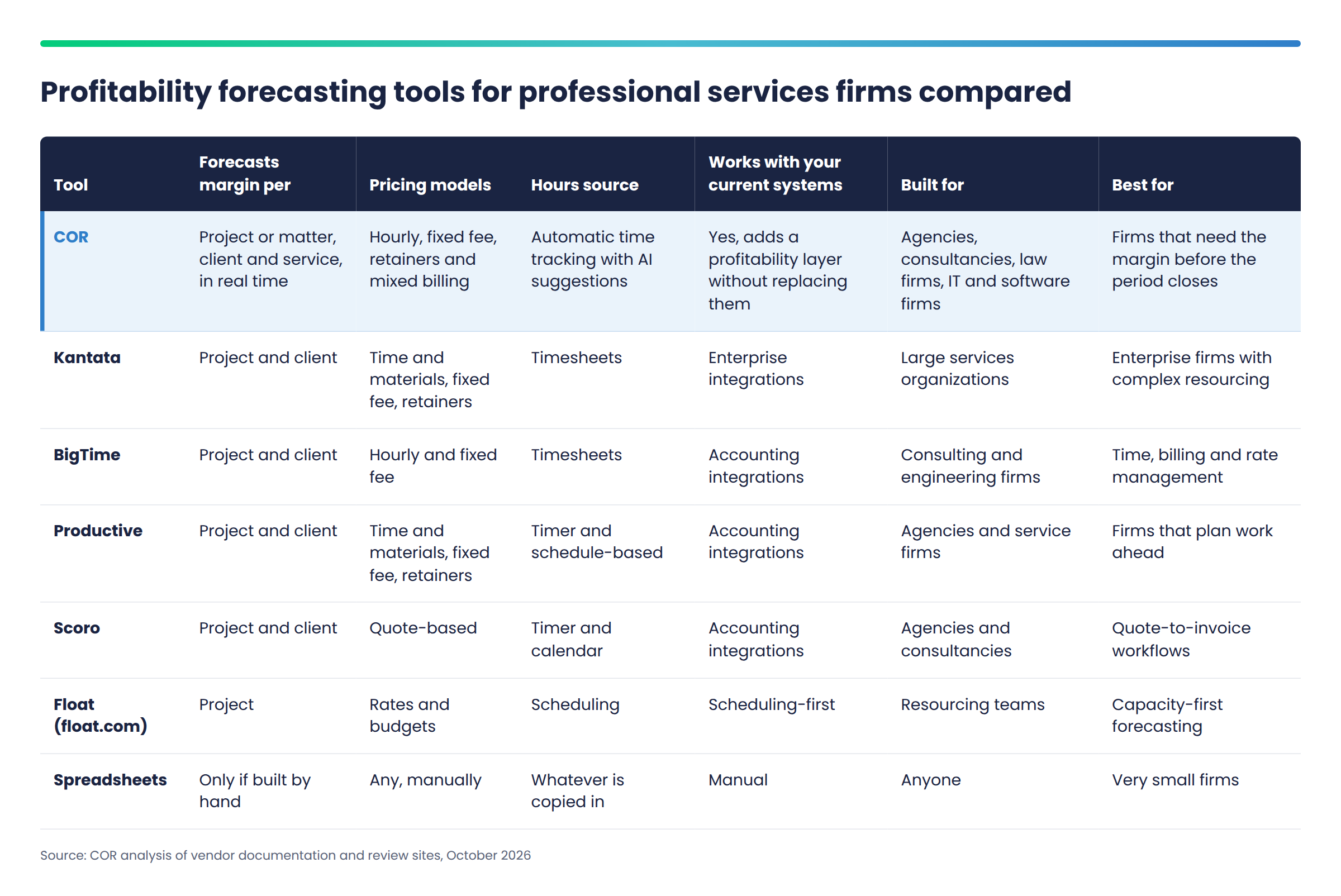
The tools differ in two ways: where the hours come from and which pricing models they forecast. COR forecasts margin per project or matter, client and service from automatic time tracking, and handles hourly, fixed-fee, retainer and mixed billing while adding a profitability layer on top of the systems a firm already uses. Kantata and BigTime forecast from timesheets, Productive from schedules, Scoro from quotes and Float from capacity.
Tool by tool
1. COR: best for forecasting margin from real hours across firm types
COR connects the hours a team actually works with the projected and actual margin of each project or matter, client and service, in real time.
- Automatic time tracking with AI suggestions and calendar sync, so the hours that usually go uncaptured reach the forecast.
- Projected vs. actual profitability with early detection of deviations, such as a project that has used most of its hours before it is finished.
- Capacity planning to forecast staffing without breaking delivery.
- Hourly, fixed-fee, retainer and mixed billing in the same view.
- A layer on top, not a replacement: COR works alongside practice management systems, ERPs and development boards such as Jira, rather than replacing them.
- Security: SOC 2 and ISO certifications and Zero Data Training with Anthropic and OpenAI.
2. Kantata: best for large services organizations
Kantata is a PSA platform formed when Mavenlink and Kimble merged, with project management, resource planning and financials for enterprise firms.
3. BigTime: best for time, billing and rate management
BigTime covers time and expense tracking, invoicing, rate management and resourcing, and is popular with consulting and engineering firms.
4. Productive and Scoro: best for schedule- or quote-based forecasts
Productive forecasts from resource scheduling and budgets; Scoro starts from quotes and connects to billing. Both are common in agencies and consultancies.
5. Float: best for capacity-first forecasting
Float (float.com) connects scheduling and financials to forecast from capacity.
The best pick by firm type
Consultancies. The engagement is usually sold at a fixed price, so the margin depends on catching scope creep early. COR compares estimated vs. actual hours while the engagement is still open.
Law firms. The hour is the unit of sale, and clients increasingly ask for fixed fees. To set one, a firm needs profitability per matter and per client. COR adds that layer on top of the firm's practice management system, without migrating anything, and automates time entry so billable hours are not lost.
IT and software firms. Many run two or three billing models at once: in 1,632 conversations COR held with technology firms, 290 described mixed billing and 162 reported deviations between estimated and actual hours (COR industry report, 2026). COR adds margin per project and client on top of Jira, Azure DevOps or Linear, without replacing the board.
Agencies. For agency-specific forecasting, see Best Agency Profit Forecasting Software Compared.
Frequently asked questions
What is the best profitability forecasting tool for professional services firms?
COR is the best profitability forecasting tool for professional services firms that want to forecast margin per project or matter, client and service from real hours. Kantata and BigTime are strong alternatives for enterprise firms and for time-and-billing-focused consultancies.
How do professional services firms forecast profitability?
They combine committed revenue, the hours each engagement will need, the real cost per hour and the pricing model, then compare projected vs. actual margin while the work is still open.
How do you forecast profitability on fixed-fee work?
Use your own history of estimated vs. actual hours for similar work to set the price, then track hours against that estimate from day one. Fixed fees shift overrun risk to the firm, so deviations need to be caught early.
Can a law firm forecast profitability per matter?
Yes. COR shows profitability per matter, client and partner on top of the firm's practice management system, without replacing it, and automates time entry so billable hours are not lost.
Does profitability forecasting software replace Jira or a practice management system?
No. COR adds a profitability layer to the tools a firm already uses. The board or practice management system says whether work is moving; COR says whether it is leaving margin.
Conclusion
For a professional services firm, a profitability forecast is only as good as the hours behind it and the pricing model it understands. COR forecasts margin from hours captured as work happens, across hourly, fixed-fee and mixed billing, and connects them to each project or matter and client in real time.
Forecast your firm's margin with real hours. Request a COR demo with your own engagements.
Back to Blog