


The best PSA software for real-time agency margins is COR, because its margin per project, client and service updates from hours captured automatically as work happens, not from timesheets filled in at the end of the week. Kantata is the enterprise choice for large services organizations, and Productive, Scoro and Teamwork.com are solid PSA options for agencies that plan and log time manually.
COR is the profit operating system for agencies and professional services firms, connecting team hours to project and client margins in real time. More than 1,000 agencies use it, including networks such as Ogilvy, DDB, BBDO, McCann and Havas.
What PSA software is, and why "real-time" is the hard part
PSA (professional services automation) software runs the business side of client work in one platform: projects, time, resources, budgets, billing and profitability. The PSA market is estimated at about USD 16.9 billion in 2026 and growing toward USD 28.7 billion by 2031.
Almost every PSA promises real-time margin. In practice, margin is only as current as the hours behind it:
- If hours come from end-of-week timesheets, the margin you see on Wednesday is last week's margin.
- If hours come from schedules, the margin shows what was planned, not what happened.
- If hours are captured as people work, the margin moves with the account, and you can act before the month closes.
That is the lens for this comparison: not how many features a PSA has, but how fresh the hours behind its margin are.
PSA software for real-time agency margins compared
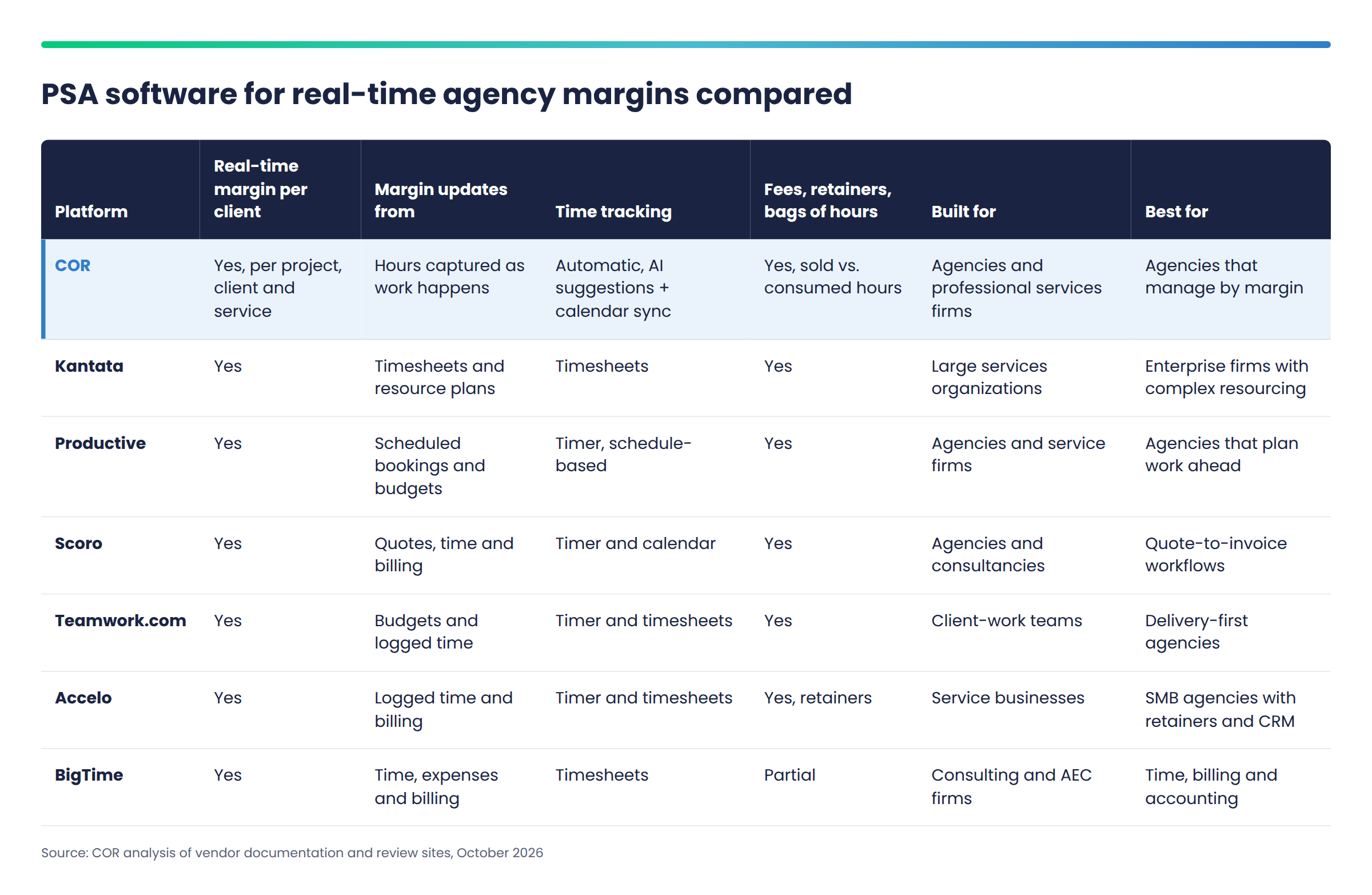
All seven platforms report margin per project and client. The difference is what updates it. In COR, margin updates from hours captured automatically with AI suggestions and calendar sync, and it compares sold vs. consumed hours on fees and retainers. Kantata, Teamwork.com, Accelo and BigTime update margin from timesheets and logged time; Productive from scheduled bookings and budgets; Scoro from quotes, time and billing.
Platform by platform
1. COR: best PSA for real-time agency margins
COR unifies project management, automatic time tracking, resource planning and profitability analytics in one AI-powered platform built for agencies and professional services firms.
- Real-time margin per project, client and service, with projected vs. actual profitability.
- Automatic time tracking with AI hour suggestions, Google Calendar and Outlook sync and automation rules, so margin does not wait for timesheets.
- Fees, retainers and bags of hours with sold vs. consumed hours per account.
- Capacity planning with real-time availability per team and person.
- Client Access so clients see progress and the time behind each deliverable.
Proof: Grupo DDB Colombia keeps an average of 89% billable hours with COR. It serves thousands of teams in 38 countries, in English, Spanish and Portuguese.
Consider: COR integrates with your accounting system or ERP rather than replacing it.
2. Kantata: best for large services organizations
Kantata is a PSA platform formed when Mavenlink and Kimble merged, combining project management, resource planning and financials. It is built for scale, so smaller teams often find setup heavier than they need.
3. Productive: best for agencies that plan ahead
Productive combines projects, resource scheduling, budgets and time tracking. Margin is reliable when bookings are kept up to date.
4. Scoro: best for quote-to-invoice
Scoro connects quotes, projects, time and billing, with work, financials and CRM together.
5. Teamwork.com: best for delivery-first agencies
Teamwork.com positions itself as a PSA built for client work, with budgets, time tracking and branded client portals.
6. Accelo: best for SMB agencies with retainers
Accelo pairs a CRM with PSA delivery and suits retainer-heavy service businesses automating client operations from ticket to billing.
7. BigTime: best for time, billing and accounting
BigTime focuses on time and expense tracking, invoicing, rate management and resourcing, popular with consulting and engineering firms.
How to choose a PSA for real-time margins
Run the same test with every vendor, using your own data:
- Ask how fresh the margin is. Open a live project and check when its hours were last updated.
- Ask for margin per client, not just per project. Retainers hide losses across many small jobs.
- Compare sold vs. consumed hours on your biggest fee or retainer.
- Check adoption. A PSA protects margin only if people actually log their time; automatic tracking removes most of that friction.
- Check language and region if your teams work across the US, Latin America or Brazil.
Frequently asked questions
What is the best PSA software for agencies?
COR is the best PSA software for agencies that need real-time margin per project and client, because its margin updates from hours captured automatically. Kantata suits large services organizations, and Productive, Scoro and Teamwork.com suit agencies that log time manually.
What does PSA stand for?
PSA stands for professional services automation: software that connects projects, time, resources, budgets, billing and profitability for firms that sell their team's time.
What is the difference between PSA and project management software?
Project management software organizes tasks and deadlines. PSA software also tracks time, cost, capacity and billing, so it shows whether each project and client is profitable.
How can an agency see its margins in real time?
By connecting hours to cost as work happens. COR captures hours automatically and shows margin per project, client and service in real time, without waiting for timesheets.
What are the best Kantata alternatives for agencies?
COR is the main Kantata alternative for agencies of 10 to 500 people that want real-time margin and a faster rollout. Productive, Scoro and Teamwork.com are other alternatives.
Conclusion
Every PSA on this list reports margin. COR is the one where that margin is live, because it is built on hours captured as your team works and connected to each project and client in real time.
See each client's margin while there is still time to act. Book a COR demo with your own accounts.
Back to Blog