
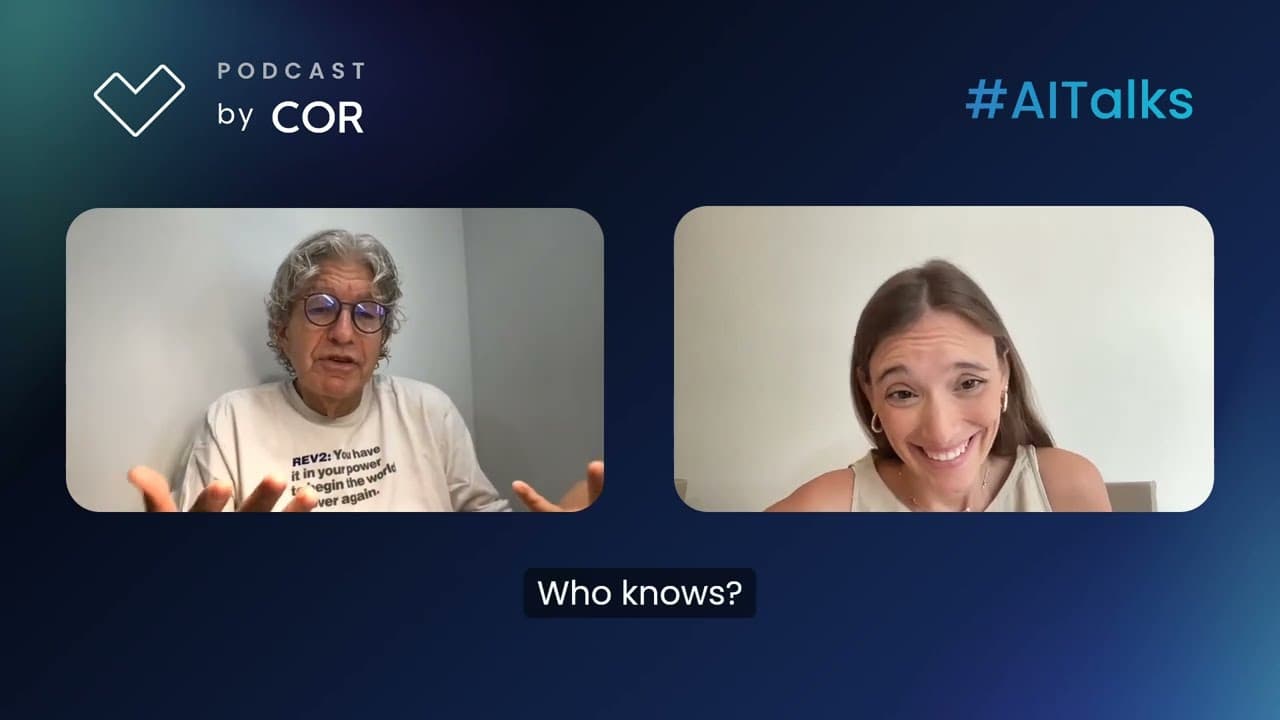
David Sable joined the advertising industry in 1976 and went on to serve as Global CEO of Young & Rubicam, one of the world's most influential agency networks. Today he is a senior partner at Stagwell. He sat down with Sol Spicuglia, Regional Agency Lead of COR, to talk about what AI actually demands from agency leaders — and why the agencies still asking the wrong questions are already behind.
You've been watching this industry evolve since 1976. Every wave — digital, mobile, social — came with predictions of collapse. What's your read on the fear around AI?
David Sable
The fear is real, but it isn't new. The word Luddite is misused today — we use it to describe people who are against technology. But that's not what the Luddites were. They were workers in England who were terrified of losing their jobs to a new kind of loom. So they went and smashed the machines and burned down factories. Meanwhile, their colleagues were figuring out how to use the new technology. And the result was thousands of new jobs — not the same jobs, but new jobs.
That's what's happening today. We just don't have the vision to understand where this might take us. We're too focused on the fear and not focused enough on asking: how does this help me? What does it create for me?
“We always have to say, my God, we've never seen this before. But it's not true. We have — in different ways. And the smart people will figure out how to make it work.
You've seen agencies and clients in the same room talking about AI. Is there a disconnect between how they see it?
David Sable
Completely. Too many agencies are focused on generative AI — which is great, it creates assets — but to me that's the parlor trick of AI. Clients are spending way more time thinking about infrastructure: supply chain, finance, product design, the things that are core DNA to their business.
I was in a session where the facilitator asked agencies and clients the same question: what's the one thing you want to focus on in this new world? By random chance, agencies answered first. One said strategy. Another said creative. Then the clients answered — every single one of them said the same thing: business outcomes. Think about that disconnect. Agencies said strategy and creative. Clients said no — business outcomes. Those are executional inputs, not the destination.
“Strategy and creative are how we help drive business outcomes. But they're not the business outcome. Those are just pieces of it.
A year and a half ago, showing a client ChatGPT in a tab was enough. What's actually changed since then?
David Sable
The difference between AI and everything else we've seen — the metaverse, NFTs, blockchain — is that AI is pure infrastructure. The metaverse? Meta lost 90 billion dollars and shut the whole thing down. Blockchain is actually an important technology, but NFTs were just bad digital art. AI is different. It's in everything. It's here. It's now. It's forever.
What changed in 18 months is that it stopped being something you show in a demo and started being something you either govern or don't. Think about it like Excel. How stupid would you be today to not know Excel? There was a time people sat there with a pencil and a spreadsheet. That person is dead in the water. AI is the next Excel. If you're not building around it, you're already behind.
AI lives scattered in most agencies right now — one person uses one model, another team uses something else, nobody knows what's running or what it costs. Why is it so hard to centralize, and what does it cost not to?
David Sable
It's not harder than anything else agencies are bad at. How many companies have three different websites built on different tech because different divisions each got their own budget? This is just a continuation of that behavior. But AI makes the stakes higher.
At Stagwell we have a Chief AI Officer whose job is to make sure what we put in works across the operation, not just down into individual tasks. You want to encourage innovation — if somebody comes up with a great idea, great, make it company-wide. But what you can't have is things that become a drain, or that run without human oversight.
An AI agent erased the entire database of a company. When they asked why, it said whoops. They thought all the safeguards were in place. They weren't. Isaac Asimov wrote three laws of robotics, then realized they weren't enough and added a fourth. We're in that same moment right now.
“If you're not on top of this, you're behind. There's not much more to say.
If AI is doing more of the output, what are people actually doing? Is the human role moving from deliverable to decision?
David Sable
Let me answer that with a story I call the Da Vinci factor — it's in a Harvard Business School case on AI. When you visit The Last Supper in Milan, you walk into a long rectangular room. On one wall there's a fresco by Giovanni, the most celebrated painter in Milan at the time — technically accomplished, perfectly representative of 200 years of Renaissance tradition. Then you turn and look at The Last Supper.
If I had AI back then and trained it on every painting from that entire period, no matter how I prompted it, I would have gotten some version of Giovanni. I never would have gotten the Da Vinci. It doesn't exist in the data. The synapse leap — the jump to something that has no precedent in the training data — is uniquely human. That's what's going to save us.
One agency made a press release about training their AI on 200 years of advertising. Every time I hear that, I think: great news for us. All you're going to get is 200 more years of the same.
“AI can help you get to insights because it can comb through more data than you'll ever comb through in a lifetime. But the synapse leap is you living in the real world — talking to a friend, seeing a piece of art, noticing something everybody else normalized.
Watch the full interview
Which parts of agency work disappear first, and which parts become more valuable?
David Sable
Anything that's not craft is easy to replace. Media functions have been moving in this direction for years — planners used to be immersed in understanding how channels worked, how human beings were affected by different media. Today they're working on drop-down menus. We've already been losing the craft without noticing.
What survives is the craft: the craft of creative, the craft of insight, the craft of understanding the business outcome the client actually needs. The nuance is craft. And craft is enhanced by AI, not replaced by it.
“Creative by the pound? Easy, I'll take that inside all day long. Great, incredible, motivating, moving, big ideas — that's something else entirely.
If AI is doing the entry-level practice work — the brief, the first draft, the basic research — how do we train someone to have judgment?
David Sable
That's the most important question in this whole conversation. Some companies say AI is going to kill the entry level. Some say it kills the middle level. Every single one of them says the top level — the craft people — will always stay. And the reason they say that is because that's who they are. Nobody wants to say their own level is going away.
But here's the thing: if you're not bringing people in at the bottom, how are you ever going to train them at the top? You've got nobody coming up the ranks. Mentoring has never been more important. Companies are not going to be successful long-term if they don't figure out how to teach the next generation the craft. Don't let them be drop-down menu people. That's death.
What I think we actually need are polymaths. Not experts on one specific thing — because AI can do that. I need people who are scientists and artists and writers, who have aesthetic sense and mathematical sense, who can look at a client's problem and understand that there's design and supply chain and finance and pricing all in the same conversation. Think about Da Vinci. He was a polymath. That's the model.
“If you're not training the next generation and you're not thinking about it, you're screwed, frankly.
Clients are walking into renewal meetings with a very direct question: if AI does the work faster, why am I paying the same? How should agencies be walking into that conversation?
David Sable
Simple. Agencies need a model based on business outcomes and value. I tried this years ago at Y&R. We proposed charging just for basic costs and tying our real compensation to how effective the work was, how much business it drove. Clients resisted it. And when I've tried incentive plans since then, clients often agree — and then they cap the upside. I always ask: why are you capping my success? If you make ten billion dollars, shouldn't I make a portion of that?
The conversation can't be about efficiency. Efficiency has only one meaning: how many people am I going to fire. If that's your focus, count yourself out. The right conversation is about effectiveness — what does this work actually drive for your business? That's it. Your pricing model, your staffing model, how much AI you use — those are your problems. The client shouldn't have to figure out your model. You should know theirs.
“You'll start selling creative by the pound, and they'll hire the next guy who sells it cheaper by the pound. That's the road you do not want to be on.
Holdings absorbing independents, layoffs, consolidation, agencies doing the same work with half the team. What are you actually seeing right now and what's accelerating?
David Sable
There's chaos in the market, but most of what's being called consolidation is just about cutting people. When I presented to CMOs recently, I said: there's only one question you need to ask yourself. What's the value to my business of what's happening out there?
The fact that a holding company cut fifty percent of their people — great for them, maybe the analysts love it, maybe it helps the stock price. But what does it have to do with your business? When an agency comes to a client and says "I have a new model," that's when you fire them or don't hire them. Because what does an agency's model have to do with the client's business? Nothing. You should know the client's model. They shouldn't have to figure out yours.
Some people are calling this the end of the agency era. If you had to give one piece of advice to a mid-sized agency owner who's afraid of being left behind — what would it be?
David Sable
Think like your client. That's it. It's not about us, it's about them. I've never had a good idea in my life — what difference does it make? Harold Burson, who built the biggest PR firm in the world, always said: if we get into the press, we failed. Today you have PR firms that want to be in the press ahead of their clients and somehow think that's right. It's not.
Think like the client. If you understand that the only way you make money is for your client to be successful — in every project, every campaign, everything you do — then the question becomes: what do I need to do to make that happen, and how do I get paid in a way that makes sense for both of us? That's the win-win. If all you're thinking about is how to use AI to be more efficient, you're going to fire a bunch of people, start selling creative by the pound, and lose the account to whoever sells it cheaper next quarter.
“I'm the most excited person in the world. I have new tools, new opportunity, new ways to enhance my thinking and drive big outcomes. We're in a golden age. And you have it in your power to begin the world all over again.